



On the occasion of World Day for Audiovisual Heritage – October 27, we celebrate the broadcasters and producers who have captured our local heritage, transforming our history from still photography into moving pictures.
During the 1940s, the British Government established the Colonial Information Office to share WWII news with citizens, primarily through British newsreels shown in local cinemas. In 1950, the Office sent Film Librarian Wilfred A. Lee to Jamaica for film production training, where he produced the first local film, “Cocoa Revitalisation”.
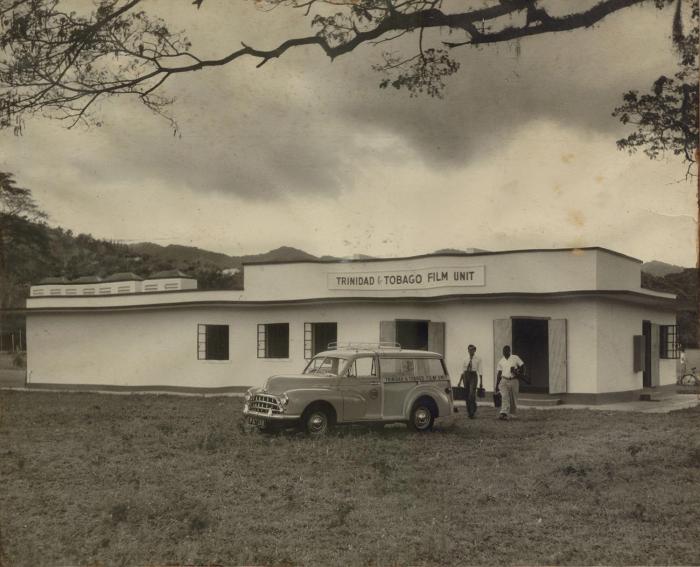
Following Lee’s training, a local Film Unit was established in June 1954. Construction of the Film Centre in St. James was completed in 1955 and included offices for the Film Unit, cutting room, film storage vaults, 16mm and 35mm libraries, recording studio and a small cinema. Film processing however was done in London, causing delays and high costs. Among the first film producers and cameramen were Wilfred Lee (Head of Unit), Sydney Hill, Raymond Dardaine and Levi Taitt. They were later joined by Roy Boyke, Evans Reid, Lennox Richardson, McDonald Canterbury and Roy Rique. Wilfred Lee eventually formed his own film company – Wilfred A. Lee and Company Ltd.


Photos from top to bottom: Wilfred Lee, Levi Taitt and Wilfred Lee on location, Sydney Hill, Raymond Dardaine (second from left) and Roy Rique (far right) with Steenbeck officials in Germany.
At Independence, the Colonial Film Unit became the Government Film Unit under the Public Relations Division of the Office of the Prime Minister, educating and informing our new nation. With the introduction of video and television in later years, the Government Film Unit became the Television Unit of the Government Information Division and continued to produce local videos.
Films produced by the Government Film Unit have been digitised and are available for viewing by appointment in the National Archives’ Public Search Room. Please email your request to enquiries@archives.gov.tt
A Preliminary Guide to the National Archives’ Audiovisual Collection (2022), including films produced by the Government Film Unit, is available at: https://us-west-2.protection.sophos.com?d=l1nq.com&u=aHR0cHM6Ly9sMW5xLmNvbS9vZTRvZTdw&i=NjU5ZWY2YmZlNGU4NTA2ZjdiZTczNTRh&t=eWFoY3VFVjZwVTdiU1NHdFRIMHdFNUpySjJJRm5lMDZENXA0RThKZFRXYz0=&h=c176bb8d4b154de6af517c0ef6c15cb5&s=AVNPUEhUT0NFTkNSWVBUSVYkOLTLrwlB-Z2G7J1YFJ_bCRCDPHwqBMTb7wYBpgrkMg
Copyright ©️The National Archives of Trinidad & Tobago. All rights reserved.
Special thanks to Roy Rique and Elizabeth Lee Laydoo for information and photos shared.
References:
- Annual Reports of the Information Officer/ Office – 1950,1951, 1952, 1955,1956.
- Lee, Wilfred. Film Production in Trinidad, December 1956.
- Samuel, Anthony. The Development of the Government Information Machinery 1940-1998. Caribbean Studies Thesis.
- A Preliminary Guide to the National Archives’ Audiovisual Collection (2022).